
INPSN
INTELLIGENT PREDICTIVE SAFETY NETWORK
a new class of frequency-intelligent spatial safety network.

A New Class of Spatial Intelligence for Safety
An integrated intelligence infrastructure for real-time safety command.
Where safety gains perception. Where environments become intelligent.
INPSN is a defence-aligned, frequency-intelligent spatial command network that converts physical environments into continuously perceived safety domains. Powered by ultra-wideband (UWB) spatial motion sensing, behavioural intelligence cognition governed by the MYTHIC Coordination Entity, and integrated human-command orchestration systems, INPSN reconstructs live movement, posture dynamics, spatial density formations, and environmental disturbance signatures into navigable 3D / 360° spatial command views, enabling real-time situational awareness across complex estates and extended operational zones without biometric surveillance or identity tracking.
INPSN establishes a new sovereign class of safety infrastructure where perception precedes incident, transforming static physical environments into legally compliant, accountable intelligence layers capable of proactive risk detection, human-authorized intervention guidance, and fully auditable safety governance.
The institutional visual overview of INPSN is being composed for governed release. Publication is intentional, not scheduled.
Where Space Becomes Intelligence
A New Intelligence Layer for the Physical World.
INPSN establishes a sovereign class of spatial intelligence, a frequency-driven command layer that transforms physical premises into actively perceived, continuously interpreted safety environments.
Instead of relying on cameras or delayed human reporting, INPSN reads how space itself behaves. Using ultra-low-power micro-burst perception and synchronized mesh cognition, it reconstructs human movement, posture dynamics, crowd formations, and environmental disturbances as live 3D / 360° spatial intelligence across entire estates.
This creates a continuously aware digital twin, enabling owners, supervisors, and safety directors to see, interpret, and govern their environments with precision, long before incidents emerge.
All intelligence is non-biometric, non-visual spatial intelligence designed privacy-aligned, and fully governed under lawful command control.
INPSN elevates security from reaction to prediction, delivering continuous situational certainty, auditable command oversight, and defence-aligned operational governance.
EXAMINE THE SPATIAL INTELLIGENCE DOCTRINEThe Architecture of Spatial Intelligence Cognition
A new class of intelligence that recognizes movement, behaviour, and risk before it forms.
INPSN transforms physical premises into a live cognitive environment, one that perceives, interprets, and responds to spatial behaviour in real time. Using frequency-intelligent UWB perception grids, INPSN reconstructs posture flow, crowd formation, object disturbances, and environmental anomalies as navigable 3D/360° spatial intelligence, without cameras, identity tracking, or biometric surveillance.
“This intelligence does not merely observe. It understands, interpreting how behaviour evolves across space.”
Through MYTHIC, the Behavioural Cognition Entity, INPSN interprets motion, posture transitions, congestion signatures, anomaly states, and early escalation patterns across multi-floor estates, campuses, aviation hubs, smart cities, and high-security environments. The system identifies risk before humans or traditional systems can perceive it, forecasting disorder, guiding guard response, and advising command units with actionable early-warning intelligence.
Through the NeuraLoop Intelligence Interface (NII), this spatial cognition becomes operational command. Leadership can observe the entire premises in synchronized 3D/360°, analyze behavioural signatures, redeploy guards through AI-guided spatial pathways, review historic motion intelligence, validate incidents for insurance/audit trails, and override or authorize MYTHIC’s coordinated workflows, under a fully sovereign, owner-controlled governance model.
This is not operational review. It is command-grade spatial cognition, a new operational standard where environments reveal their behaviour, risks are forecasted before escalation, and every decision is made with precision, legality, and institutional authority.
To understand how INPSN perceives, reasons, coordinates, and governs as a complete cognitive architecture, explore the full Spatial Intelligence Architecture.
EXAMINE SPATIAL INTELLIGENCE ARCHITECTUREPHYSICAL DETECTION LAYER, UWB ANCHOR NODES
INPSN operates through purpose-built spatial perception anchors deployed discreetly across architectural environments. These nodes establish the foundational frequency grid responsible for sensing motion dynamics, spatial distortions, and geometry formation without visual surveillance.
EXAMINE PHYSICAL DETECTION LAYER
SPATIAL INSTALLATION DOCTRINE
How INPSN Lives in Your Architecture
INPSN is installed as a discreet architectural layer, ceiling-line, wall-line, and perimeter-grade anchor placement that mirrors the way your buildings actually breathe. Each site is mapped into structured installation zones so that corridors, atriums, stairwells, elevators, open plazas, and outdoor approaches remain continuously covered without visual intrusion or structural disruption.
EXAMINE SPATIAL INSTALLATION DOCTRINE
FREQUENCY MESH TOPOLOGY
How INPSN Becomes One Intelligent System
INPSN’s spatial grid operates as a fully synchronized frequency mesh, where distributed perception anchors federate into a single live intelligence fabric, interpreting motion distortion across layered zones to reconstruct real-time, three-dimensional spatial awareness without biometric surveillance. This adaptive mesh links buildings, floors, and open environments into a unified command domain that enables continuous detection, reconstruction, and coordination across complex sites while preserving privacy, safety compliance, and sovereign operational control.
EXAMINE FREQUENCY MESH TOPOLOGY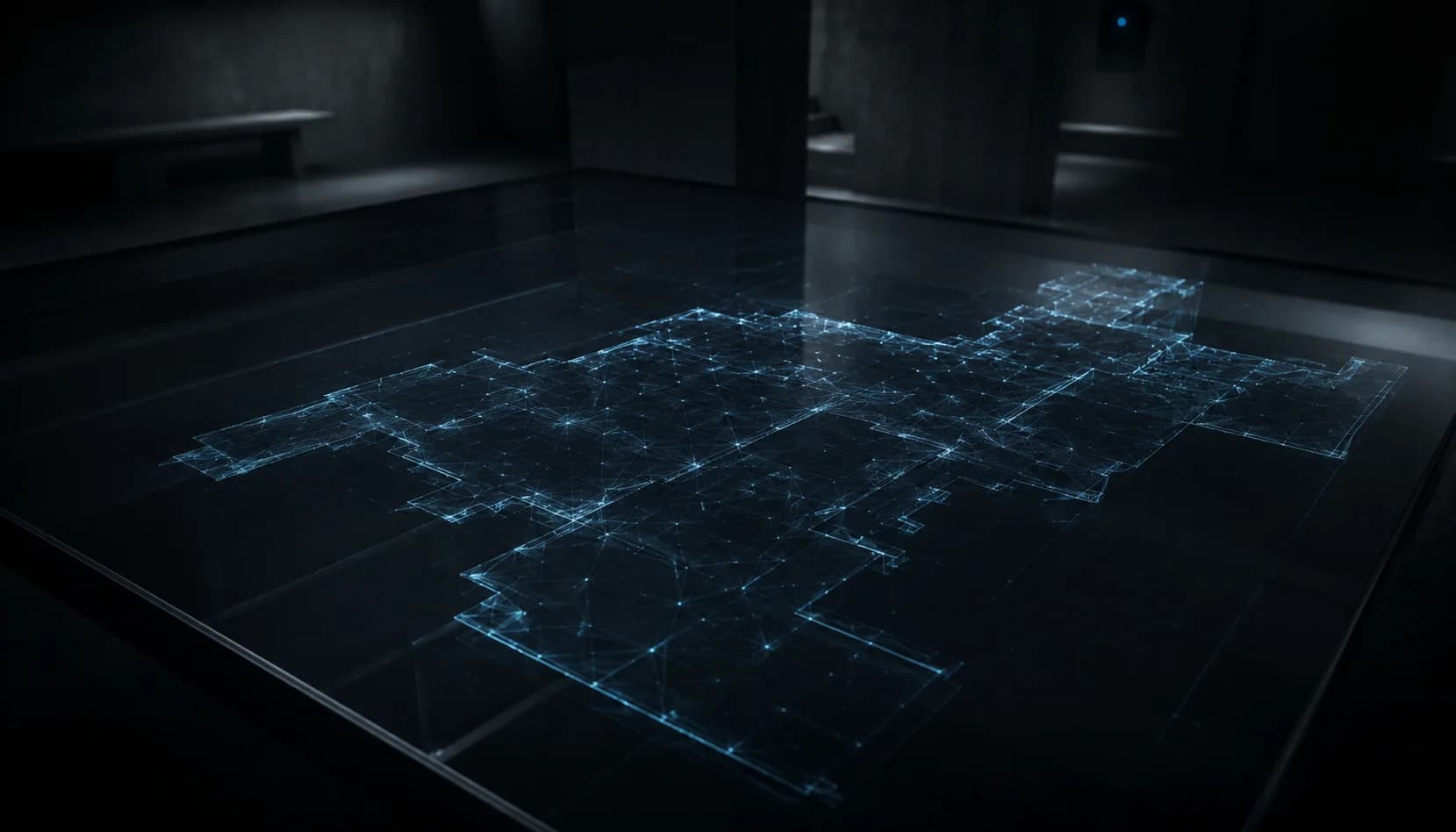
MICRO-BURST PERCEPTION PHYSICS
How INPSN “Sees” Without Cameras
INPSN perceives space through ultra-wideband micro-burst frequency sampling rather than visual imaging. Short, low-power pulse emissions propagate through the environment, reflecting and distorting around human presence, objects, and structural surfaces. These distortions are interpreted as spatial motion signatures, transforming invisible physical dynamics into live 3D / 360° motion intelligence without biometric surveillance or optical capture.
This pulse-based perception enables INPSN to continuously sense posture shifts, crowd flow, object disturbances, and environmental anomalies across entire protected premises, forming the raw awareness layer behind digital twin reconstruction, behavioural cognition processing, and command orchestration.
EXAMINE MICRO-BURST PERCEPTION PHYSICSGEOMETRY RECONSTRUCTION PIPELINE
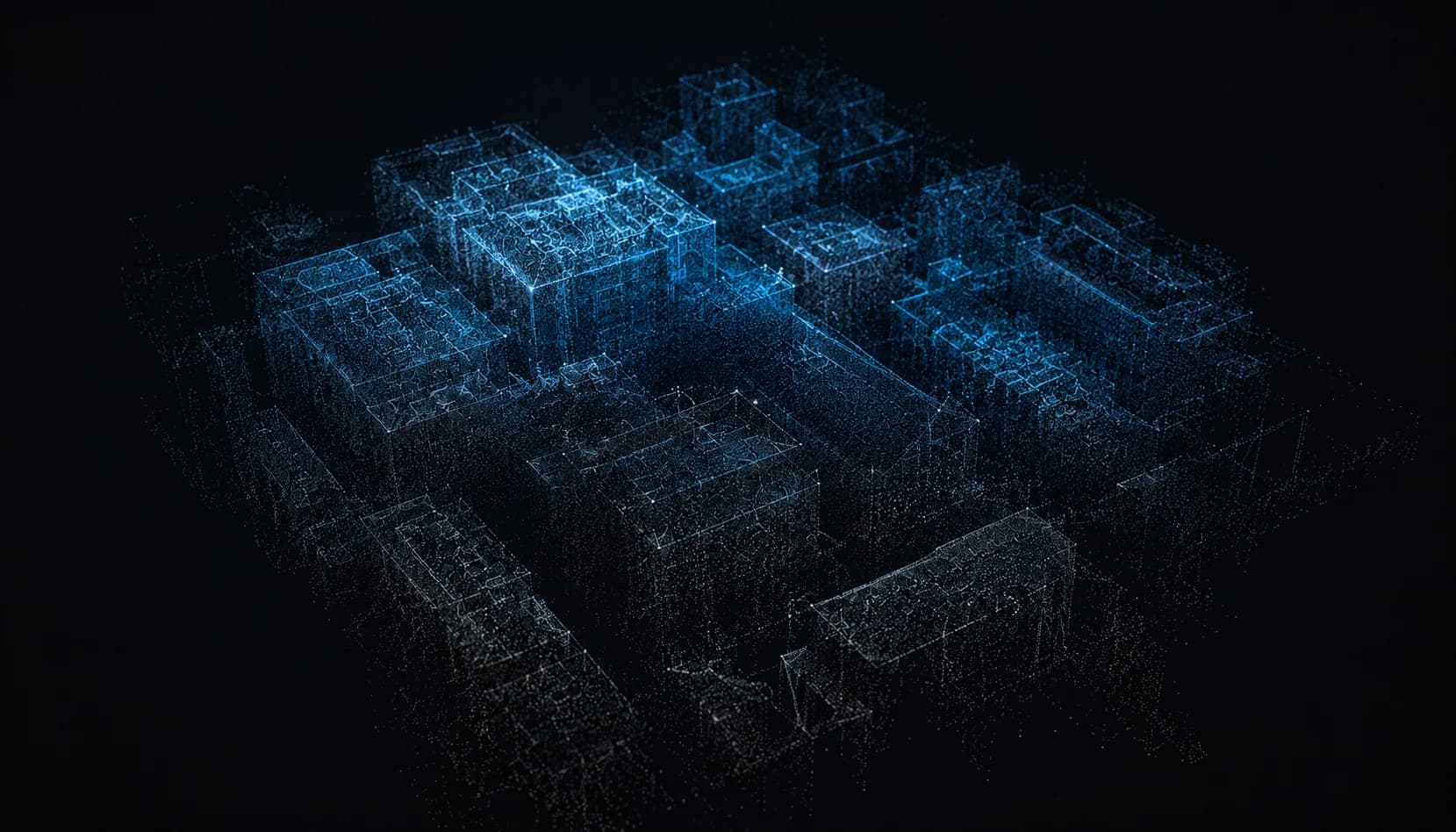
How INPSN converts frequency distortions into live spatial understanding.
INPSN’s reconstruction pipeline transforms nanosecond UWB micro-bursts into high-fidelity spatial geometry, building live 3D movement forms that preserve posture accuracy while safeguarding identity. Each frequency distortion is interpreted as spatial behaviour, routed through the cognitive pipeline, and rendered into precise geometry for MYTHIC’s behavioural evaluation.
This pipeline reveals how the environment is behaving in real time, surfacing subtle spatial deviations that are not visible through ordinary corroboration. Motion becomes geometry. Behaviour becomes pattern evolution. Risk becomes detectable long before escalation.
To understand how raw frequency signatures evolve into live 3D posture forms, explore the Geometry Reconstruction Pipeline.
Edge-side processing conducts preliminary signal conditioning and noise-normalization before reconstruction logic begins.EXAMINE GEOMETRY RECONSTRUCTION PIPELINE
DIGITAL TWIN PROJECTION LAYER
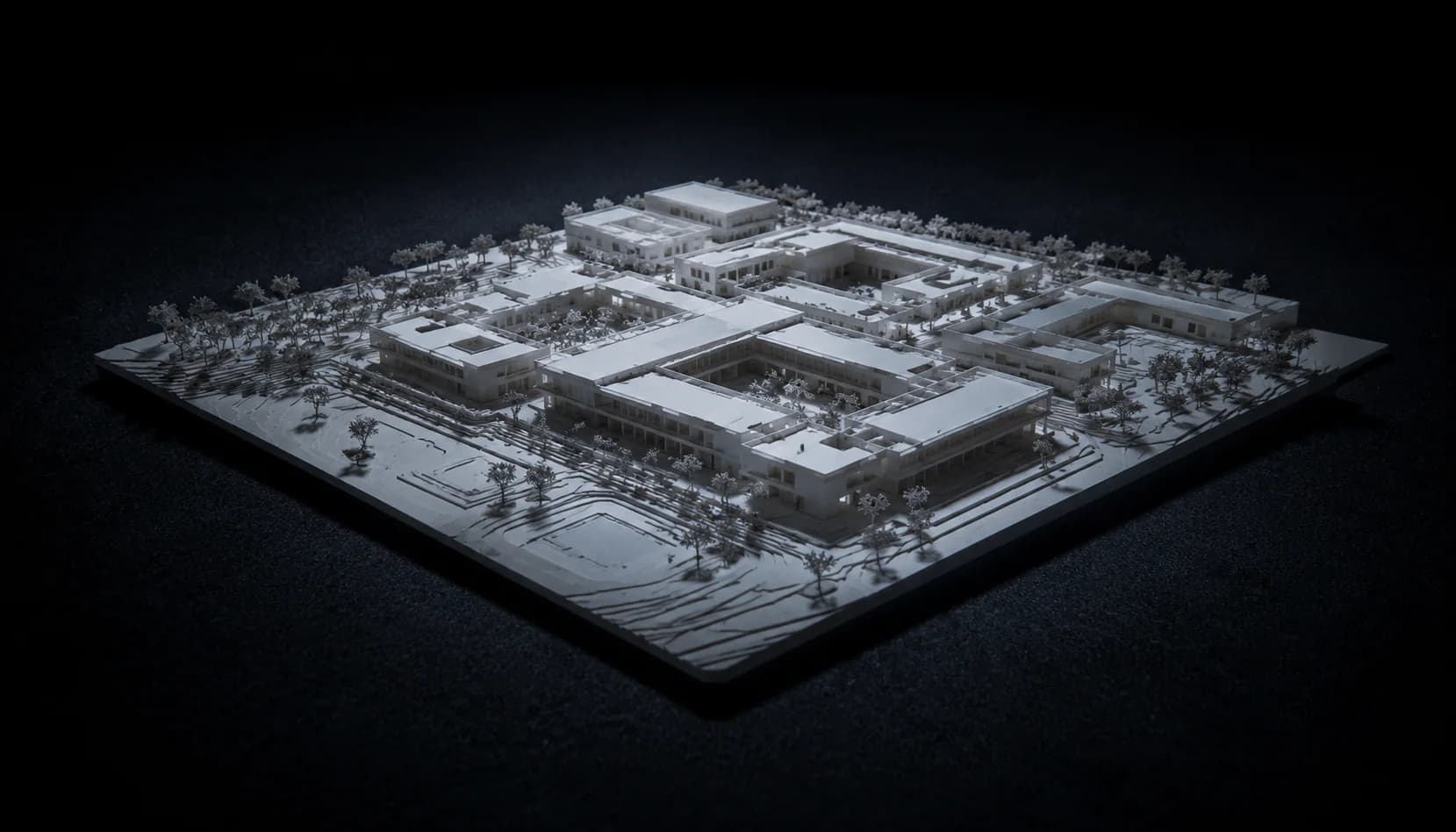
Where intelligence aligns with the estate’s true architecture.
INPSN does not interpret movement in isolation. Its spatial cognition becomes meaningful only when projected onto a measurement-accurate digital twin built from sanctioned architectural layouts and verified site surveys. This twin forms the authoritative structural map through which all posture flow, anomaly signatures, and environmental behaviours are understood in real time.
Live 3D/360° motion intelligence is continuously synchronized with this environment, allowing leadership to observe how space is actually behaving, across floors, corridors, boundaries, and high-risk zones, with a clarity unattainable through conventional operational review systems. The result is a living operational reference: a dynamic estate model where perception, behaviour, and command all converge.
To see how INPSN constructs and governs this foundation, explore the full Digital Twin Projection Architecture.
Edge computation ensures that projection latency remains minimal, allowing the digital twin to reflect live spatial states with operational immediacy.EXAMINE DIGITAL TWIN PROJECTION LAYER
VERTICAL AXIS STABILIZATION
How INPSN Maintains Absolute Spatial Accuracy Across Every Floor
INPSN treats every floor of a building as an independent spatial domain, each governed by its own precisely calibrated UWB perception grid. This ensures that movement, posture, crowd patterns, and anomaly signals are interpreted only within the correct architectural plane, without cross-floor interference or vertical confusion.
Whether a floor spans a compact mezzanine or a large commercial level, its perception mesh remains confined to its physical boundaries, preserving spatial accuracy even in complex multi-level estates.
As individuals move through stairways, lifts, or vertical corridors, INPSN reads these paths as governed transitions rather than ambiguous movement. The system maintains continuity without merging floors, allowing the digital twin to express behaviour across height with the same clarity as across horizontal space.
The result is a vertically coherent operational environment where every action is represented within its correct structural context, essential for command precision, auditability, and lawful oversight.
To see how INPSN preserves vertical stability across complex buildings, explore the full Cross-Floor Continuity Doctrine.
EXAMINE VERTICAL AXIS STABILIZATION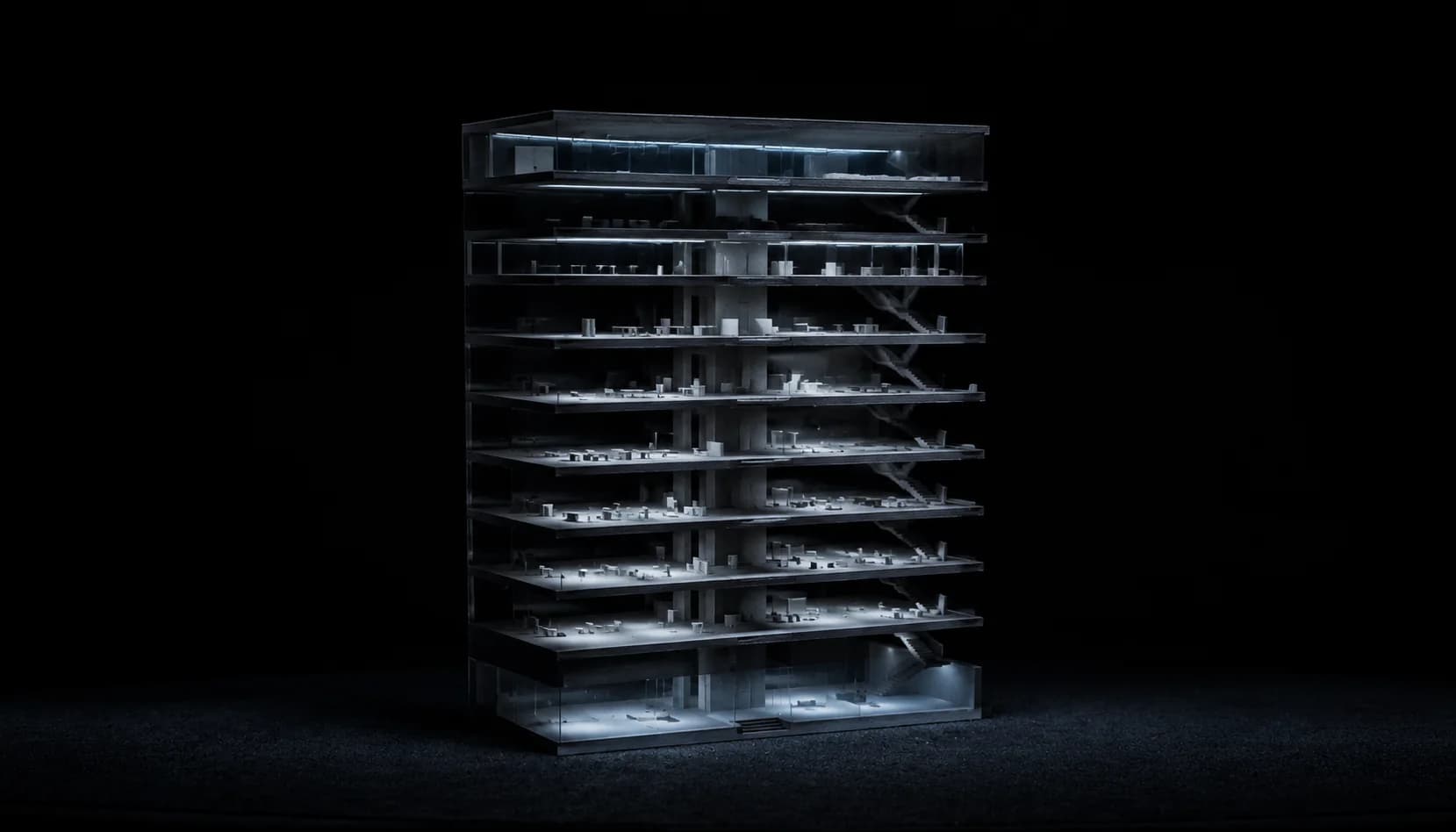
LIVE COMMAND VISUALISATION
Where Spatial Cognition Becomes Operational Authority
INPSN renders the entire estate as a live, navigable 3D/360° command theatre, where posture flow, movement patterns, crowd dynamics, object disturbances, and environmental variations appear as anonymised geometric intelligence anchored inside the digital twin. Command units can observe the full premises, isolate floors, rotate structures, examine specific zones, and follow emerging behaviours with real-time clarity across mobile, tablet, laptop, and command-center consoles.
This is not operational review in the traditional sense. It is spatial command oversight, where leadership sees how the environment is behaving, evaluates developing conditions, and governs response pathways through structured, hierarchy-based authority. Every event is preserved as a high-fidelity, time-indexed reconstruction, enabling operators to navigate past moments with the same clarity available in live view.
INPSN transforms situational awareness into institutional command, giving authorized clients the power to observe, interpret, intervene, and override from anywhere in the world.
EXAMINE LIVE COMMAND VISUALISATION
COMMAND ACTION LAYER
Where cognition becomes command. Where space responds to intent.
INPSN’s Command Action Layer turns the digital twin into a live operational surface, allowing authorized leadership to direct movement, issue redeployments, and coordinate responses through precise spatial interaction. Every instruction is translated into command-grade guidance, with validated pathways, real-time feedback, and full supervisory governance built into the process.
Spatial decisions become structured operational actions, supported by MYTHIC’s contextual situational awareness and safeguarded by the client’s sovereign control. Whether reallocating guards, resolving an emerging anomaly, or coordinating multi-zone activity, the Command Action Layer ensures that every action is executed with accuracy, legality, and institutional discipline.
To understand how spatial intelligence transitions into actionable governance, explore the complete Command Action Layer.
EXAMINE COMMAND ACTION LAYER
SAFETY PHYSICS & RF COMPLIANCE
INPSN’s perception layer is built on disciplined RF engineering designed to operate inside modern estates without altering how people or infrastructure function. Its ultra-low-intensity UWB micro-bursts coexist with the everyday electromagnetic environment created by Wi-Fi, access systems, communication devices, and building automation networks, adding an intelligence layer, not an intrusive broadcast layer.
The system continuously regulates its own emissions, stabilizing behaviour across changing architectural materials, device densities, and multi-floor environments, ensuring that spatial cognition remains consistent, predictable, and operationally coherent.
This engineering discipline also extends to aviation, maritime, convoy, and Portable INPSN scenarios, where electromagnetic coordination is mission-critical. INPSN adapts to the environment rather than requiring the environment to adapt to it.
To understand the controlled physics, compliance architecture, and RF governance principles that enable INPSN to function as a safety-aligned system across diverse infrastructures, enter the full doctrine.
EXAMINE SAFETY PHYSICS & RF COMPLIANCE
REDUNDANCY & RELIABILITY DOCTRINE
Continuity engineered into every layer of INPSN
INPSN is built to remain operational when conditions are imperfect, unstable, or actively disrupted. Its perception mesh, cognitive pipelines, and command layers are reinforced with multi-tier safeguards that preserve spatial awareness even under noise, signal fluctuation, or power variation.
Hybrid power options, UPS integration, and battery-supported Portable INPSN ensure the system stays active across diverse operational environments, while BLE continuity protects essential activity flows during temporary UWB disruption.
Edge-AI further stabilizes behavioural analysis when network latency rises, maintaining interpretation clarity until full connectivity returns. And throughout every fail-safe, the system preserves the client’s sovereignty: data remains local, cognition executes only under explicit authorization, and no external entity can access or command the system without consent.
INPSN’s reliability is not a feature, it is an operational doctrine designed to ensure safety intelligence continues exactly when it is needed most.
EXAMINE REDUNDANCY & RELIABILITY
DATA SOVEREIGNTY & SYSTEM STORAGE DOCTRINE
Where Spatial Intelligence Meets Institutional Governance
INPSN operates as a cognitive safety system without ever compromising the sovereignty of the estate it protects. All persistent spatial records, reconstructions, incident logs, and operational archives remain within the client’s secured environment, while the live cognitive engines work only on anonymised, purpose-bound event streams that disappear once processed.
This architecture ensures that MYTHIC, BIE, the reconstruction pipeline, and the 3D command environment receive only the minimum behavioural and geometric information required to function, without collecting or retaining identity-bearing or sensitive personal attributes. Every layer, frequency mesh, command interface, archival storage, and support access, is engineered to meet global privacy standards while providing defence-aligned operational reliability.
The doctrine reinforces a simple, institutional truth: INPSN delivers high-fidelity spatial intelligence while the client retains full authority over their data, their environment, and their operational history.
To understand how this governance framework protects privacy, strengthens command integrity, and enables lawful high-security deployments across global jurisdictions, explore the full doctrine.
EXAMINE DATA SOVEREIGNTY
Initiate Institutional Pathway
The INPSN pathway is approached through two institutional actions, presented in their governance order. Eligibility assessment is the entry point for any institution evaluating long-term spatial intelligence infrastructure alignment. Mandate review follows only after eligibility has been acknowledged, opening a governed pathway for institutional coordination.
Accessible after eligibility acknowledgment
This page describes system doctrine, operational intent, and safety governance. Technical parameters, implementation details, and operational thresholds are restricted and disclosed only under contractual NDA.